Should Oak Wounds Be Cauterized? What Recent Research Says About Heat, Fire, and Tree Wound Healing

The idea of using heat on a tree wound sounds unusual...
After all, arborists normally try to avoid damaging the living tissue around a pruning cut.
But the idea becomes more interesting when we look at oaks.
Many oak species developed in ecosystems where fire was a regular part of the landscape. Mature, thick-barked oaks can be surprisingly tolerant of low-intensity fire, and some research shows that certain oak species are better able to survive and compartmentalize fire injuries than many thinner-barked trees.
That has raised an interesting question:
Could carefully controlled heat, or “cauterization,” sometimes improve the response of an oak to a wound?
Research during the last several years provides some intriguing clues. It also gives us several reasons to be cautious.
The short answer is that heat can kill important tree pathogens, and some long-term oak case observations have reported successful wound closure after cauterization. However, there is not yet strong controlled research proving that burning fresh pruning wounds improves healing in oaks.
For now, cauterization should be considered experimental rather than a standard pruning practice.
First, What Does “Cauterizing” a Tree Wound Mean?

In this context, cauterization means applying heat to exposed woody tissue after an injury, pruning cut, or removal of diseased tissue.
The theory is fairly simple.
Enough heat may kill fungal or bacterial organisms on or near the exposed surface. Heat could also change the surface environment of the wound and potentially influence how the tree responds to the injury.
But there is an obvious problem.
The cambium and other living tissues that close the wound are also vulnerable to heat.
If the treatment kills pathogens but also kills several additional layers of healthy tissue, the treatment could simply turn a small wound into a larger one.
That balance between killing a pathogen and damaging the tree is one of the biggest unanswered questions.
Oaks Are Fire-Adapted, but That Does Not Mean They Are Fireproof

It is more accurate to describe many oaks as fire-adapted or fire-tolerant rather than fire-resistant.
A large 2023 peer-reviewed study led by researchers from Purdue University and the U.S. Forest Service examined 8,093 trees across 139 oak-dominated forest stands that had experienced anywhere from zero to six prescribed fires.
The researchers found that repeated prescribed fire did create wounds. Approximately 29% of the trees examined had at least one wound associated with fire.
However, species responded differently.
White oak and chestnut oak were among the species more resistant to fire-related damage. Thick bark provides insulation, and oak species can also be effective at compartmentalizing injuries after they occur.
Importantly, though, the study also showed that repeated fire can damage the cambium and create larger or persistent wounds.
In other words:
An oak's ability to survive fire does not mean additional heat is automatically beneficial to an existing wound.
Fire tolerance tells us that some oaks have biological tools for surviving heat injury. It does not prove that intentionally creating additional heat injury improves pruning wounds.
Heat Really Can Kill Tree Pathogens
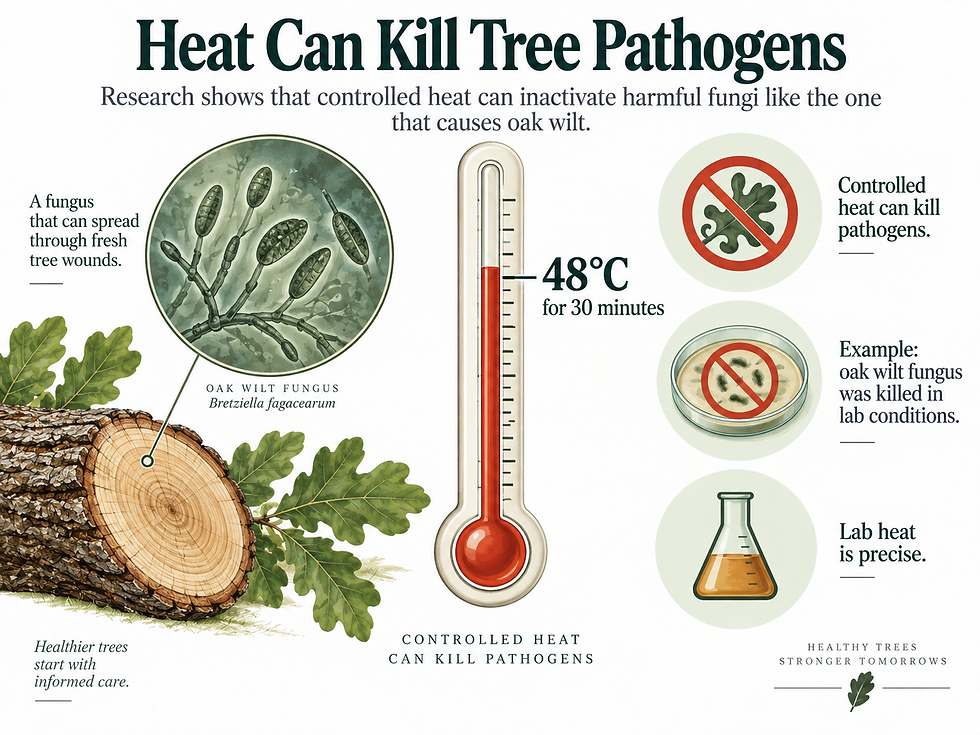
One of the strongest arguments behind cauterization is that many tree pathogens are surprisingly sensitive to heat.
A 2024 study published in Frontiers in Forests and Global Change examined the temperatures needed to kill several important forest pathogens.
One of those organisms was Bretziella fagacearum, the fungus responsible for oak wilt.
Under carefully controlled laboratory conditions, all of the oak wilt fungus isolates tested were killed when held at approximately 48°C (118°F) for 30 minutes.
Other pathogens tested in the study had lethal temperatures between approximately 44°C and 50°C during the same exposure period.
That tells us something important:
Heat absolutely has the biological ability to kill tree pathogens.
But it does not tell us that passing a propane torch over an oak pruning wound will accomplish the same thing.
The researchers were using precisely controlled temperatures and exposure times. A torch produces extremely uneven temperatures. The surface may become very hot while organisms deeper inside the wood remain relatively cool.
The researchers themselves emphasized that heat penetration through wood is complicated and that controlled laboratory results need to be connected with real-world treatment methods before conclusions can be made.
Living Oaks Have Also Been Experimentally Heat-Treated

There is another interesting piece of recent research involving living oaks.
Researchers associated with the University of California tested thermotherapy on young coast live oak (Quercus agrifolia) and valley oak (Quercus lobata) plants infected with several Phytophthora species.
In limited 2022 pilot experiments, placing the small container-grown oaks in a 47°C water bath for 30 minutes appeared to eliminate the Phytophthora infections.
That provides further evidence that it may be possible to expose living oak tissue to carefully controlled heat while killing certain pathogens.
But the researchers gave an important warning.
They described the margin between a temperature that may be therapeutic and one that injures or kills plant tissue as small. They also noted how difficult it becomes to control temperatures evenly as plants and root systems become larger.
That is extremely relevant to wound cauterization.
A controlled 47°C water bath and an open propane flame are two completely different ways of applying heat.
Five-Year and Longer Oak Observations

Some of the most interesting long-term observations come from California ecologist Lee Klinger and his work with coast live oaks.
Klinger has documented what he describes as fire mimicry, which may include several treatments rather than cauterization alone.
On some diseased oaks, bleeding stem cankers were surgically removed, the exposed area was cauterized, and additional treatments were applied.
A 2024 update documented coast live oaks that had been treated beginning in 2018. Two canker wounds on one old-growth oak had been surgically removed, cauterized and poulticed. Six years later, the photographed wounds showed substantial closure and no residual bleeding was reported.
An additional update published in 2025 followed another old coast live oak whose canker had been removed and cauterized in December 2018. Seven years later, Klinger reported continued wound closure and no visible signs of the original infection.
Those observations are worth paying attention to.
These are encouraging case observations—not proof that cauterization works.
Several treatments were performed at the same time. Some trees received canker removal, cauterization, poultices, soil treatments and other fire-mimicry practices.
There was not an identical untreated oak next to each treated tree for comparison.
That makes it impossible to determine how much of the result came from cauterization, how much came from physically removing diseased tissue, and how much came from the tree's own ability to compartmentalize the injury.
Long-term case observations can help generate good research questions. They cannot replace a controlled experiment.
There Is Also Evidence That Cauterization Can Cause Damage

This is probably the most important caution in the discussion.
One of the better controlled studies directly testing tree-wound cauterization was performed on apple trees affected by anthracnose canker.
Researchers surgically removed cankers and tested several treatments, including cauterization with a handheld propane torch.
The results were not favorable.
The researchers reported that the area injured by cauterization increased to approximately 28 times its original size, and cauterization did not provide effective disease control.
Disease symptoms were still found beneath treated areas 15 months later.
The researchers concluded that cauterization caused excessive injury and should not be used for that particular disease-management situation.
Apple is obviously not oak.
The pathogen was also different.
That means this experiment does not prove that an oak would respond the same way.
What it does prove is that cauterization cannot safely be assumed to help every woody plant simply because heat can kill pathogens.
Species, wound size, heat intensity, exposure time, bark thickness and the organism being targeted may all matter.
Trees Don't Heal Wounds the Same Way People Do
Another important part of this discussion is understanding how a tree responds to injury.
A tree generally cannot replace damaged wood with identical new tissue.
Instead, it compartmentalizes the injury.
The tree forms chemical and physical boundaries around damaged wood while new wound-wood develops around the outside of the injury.
Eventually, new growth may completely cover the exposed area.
Research on fire scars in white oak demonstrates how effective this process can sometimes be. One U.S. Forest Service study found that fire scars on white oaks eventually closed over periods ranging from approximately one year to 24 years, with larger wounds generally requiring more time.
The same research also emphasizes an important principle:
Smaller injuries are easier for a tree to close than larger injuries.
That is one reason proper pruning remains so important regardless of what future research discovers about heat treatments.
Could Cauterization Eventually Have a Place in Arboriculture?
Possibly.
There is enough evidence to justify studying it further.
We know that:
- Heat can kill important fungal and oomycete tree pathogens.
- Certain oak species tolerate fire injury better than many other trees.
- Oaks can produce substantial woundwood around fire scars.
- Limited thermotherapy experiments show that living oak material can survive carefully controlled pathogen-killing temperatures.
- Several long-term oak case observations show successful wound closure following procedures that included cauterization.
But there are still major unanswered questions.
Researchers would need to compare identical wounds on similar trees and test different temperatures, exposure times and wound sizes.
Most importantly, a study would need separate groups such as:
proper pruning only vs. proper pruning plus cauterization
and then follow those trees for several years.
Researchers would need to measure wound closure, cambial dieback, internal discoloration, fungal colonization and decay—not simply whether the outside of the wound eventually closed.
Until studies like that are completed, we cannot confidently say cauterization improves oak pruning wounds.
What Should We Do With Oak Wounds in Texas Right Now?

For North Texas homeowners, established oak-wilt prevention recommendations still apply.
Texas A&M Forest Service recommends avoiding unnecessary pruning of oaks from February through June, when oak wilt transmission risk is greatest.
Texas guidance also recommends immediately painting fresh oak pruning cuts and other wounds throughout the year.
The purpose of the paint is not to make the tree heal faster. It creates a temporary physical barrier that helps prevent sap-feeding beetles carrying oak wilt spores from reaching the fresh wound.
For most other tree species, routine wound paint is generally not recommended.
There is currently no Texas A&M recommendation to cauterize routine oak pruning wounds.
Our Conclusion
Cauterizing oak wounds is an interesting area of arboricultural research, but the science is not mature enough to call it a proven pruning treatment.
Current research gives us several pieces of the puzzle.
Heat can kill serious tree pathogens. Some oak species tolerate heat injury and compartmentalize fire wounds surprisingly well. Long-term observations of cauterized coast live oak cankers are encouraging.
But we also have controlled evidence from another tree species showing that excessive heat can dramatically enlarge a wound without controlling the disease.
Those findings should keep us from making the leap from:
“Oaks are adapted to fire”
to:
“Burning an oak pruning cut is good for the tree.”
Those are very different conclusions.
At Case Tree Service, we believe new techniques are worth studying, especially when they could eventually improve tree preservation. But being interested in an experimental treatment is different from recommending it to a customer.
For routine oak pruning today, the best-supported approach remains proper pruning cuts, preservation of the branch collar, avoiding unnecessarily large wounds, appropriate pruning timing, and immediate wound painting on Texas oaks for oak-wilt prevention.
If future controlled studies demonstrate that precisely applied heat improves compartmentalization, limits decay or reduces pathogen establishment in fire-adapted species, cauterization could become an interesting tool.
For now, the evidence says “promising enough to study,” not “proven enough to routinely practice.”
---
Sources and Further Reading
Saunders, M.R., Mann, D.P., Stanis, S., Wiedenbeck, J.K., Dey, D.C., & Schuler, T.M. (2023). “Prescribed Fire Causes Wounding and Minor Tree Quality Degradation in Oak Forests.” Forests, 14(2), 227. Research included 8,093 trees across 139 oak-dominated stands.
Leal, I., John, E.P., Souque, T.J., Tanney, J.B., Uzunovic, A., et al. (2024). “Evidence to support phytosanitary policies—the minimum effective heat treatment parameters for pathogens associated with forest products.” Frontiers in Forests and Global Change. The study included the oak wilt pathogen Bretziella fagacearum.
University of California, Davis / Swiecki & Bernhardt (2022; updated UC Davis guidance 2024). Thermotherapy pilot work involving Quercus agrifolia and Quercus lobata infected with Phytophthora species.
Stambaugh, M.C., Smith, K.T., & Dey, D.C. (2017). “Fire scar growth and closure rates in white oak (Quercus alba) and the implications for prescribed burning.” Forest Ecology and Management, 391, 396–403.
Garton, W.J., Mazzola, M., Dasgupta, N., Alexander, T.R., & Miles, C.A. (2018). “Efficacy of Excision, Cauterization, and Fungicides for Management of Apple Anthracnose Canker in Maritime Climate.” HortTechnology, 28(6), 728–736.
Klinger, L. (2024–2025). Long-term coast live oak fire-mimicry and canker-surgery case observations, including six- and seven-year follow-ups of wounds treated with surgical removal, cauterization and additional treatments. These are observational case reports rather than controlled experiments.
Texas A&M Forest Service (2025). Current Texas oak-wilt prevention guidance: avoid pruning or wounding oaks from February through June when possible and immediately paint fresh oak wounds.
Comments